Manufacturing Process Optimization: Reduce Costs and Increase Output
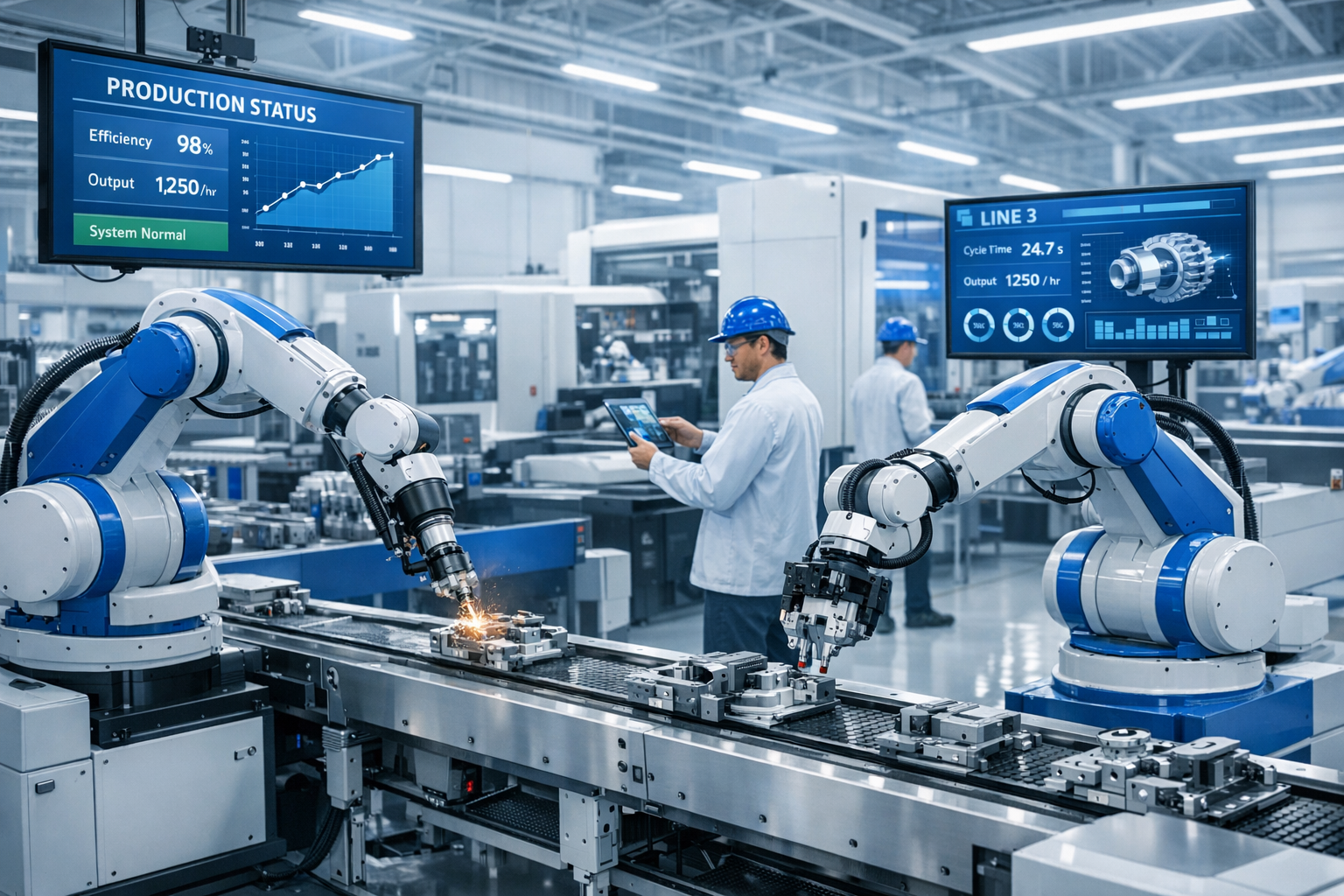
Manufacturing process optimization means getting more good output from the same plant, people and materials by removing the losses that slow production down. Start at the constraint, measure the losses with real data, fix the biggest one with standard tools such as lean and Six Sigma, and lock the gain in with standard work before you move on.
This guide is for plant managers, COOs and owners of mid-market manufacturers. It covers where to look first, a step-by-step method, the techniques that work on the floor and the measures that show whether it is working.
Our manufacturing process optimization consulting follows the same method on the plant floor.
Key takeaways
- Optimize the constraint first. Gains anywhere else rarely raise plant output.
- Measure losses before changing anything: downtime, changeovers, scrap, rework and waiting.
- Lean removes waste and variation reduction removes defects; most plants need both.
- Technology helps when the process is already stable and measured.
- A change is not finished until it holds on every shift.
What is manufacturing process optimization?
Manufacturing process optimization is the systematic work of improving how a process turns materials into finished products, so it delivers more good units at lower cost without hurting quality or safety. It focuses on the losses between what a line could produce and what it actually ships.
Production optimization is the same idea applied to the whole production system: scheduling, staffing, changeovers and material flow, not only a single machine.
Process improvement vs process optimization
Process improvement is any change that makes a process better. Process optimization is improvement aimed at a specific target, such as maximum throughput at the constraint or minimum cost per good unit, with the trade-offs measured.
In practice the two overlap. The difference is discipline: optimization starts from a clear objective and data, not from a list of ideas.
Where to look first: the most common losses
In most plants, cost and capacity are lost in a few familiar places. Walk the floor and check these before buying anything new.
- Unplanned downtime on the constraint machine or line.
- Long or frequent changeovers, especially when product mix is growing.
- Scrap and rework that are written off without a root cause.
- Waiting for materials, approvals, maintenance or quality release.
- Extra handling and motion between operations.
- Overproduction and excess inventory that hide problems and tie up cash.
- Manual data and workarounds that delay decisions.
How to optimize manufacturing processes, step by step
Use the same sequence every time. Each step needs evidence before the next one starts.
- Set the objective. Decide what you are optimizing: output, cost per unit, lead time or quality. One primary goal keeps the work focused.
- Find the constraint. Identify the step that limits plant output today, using line rates, queues and downtime data.
- Measure the baseline. Record output, downtime, changeover time, scrap and labor hours at the constraint for a representative period.
- Map the process. Walk it on every shift and record where material and information wait.
- Find the root causes. Rank losses by size and dig into the biggest one with simple tools such as Pareto charts and the 5 whys.
- Test a change. Pilot it on one line or shift with clear acceptance criteria, including quality and safety.
- Standardize. Write the new method into standard work, train every shift and update the control plan.
- Sustain and repeat. Review the measure daily until it holds, then move to the next constraint.
Techniques that work on the plant floor
Pick the tool that matches the loss you measured. Applying every tool at once spreads the team too thin.
- Value stream mapping: shows waiting, handling and inventory across the whole flow.
- Quick changeover (SMED): converts internal setup steps to external ones done while the machine runs, then shortens what remains.
- Total productive maintenance: production teams take on daily equipment care and maintenance focuses on planned and preventive work, to reduce breakdowns.
- 5S and visual management: makes abnormal conditions visible at a glance.
- Standard work: one best-known method for each critical task, followed on every shift.
- Six Sigma (DMAIC): reduces variation and defects when the cause is not obvious.
- Pull and kanban: links production to real demand and cuts excess inventory.
For how these fit together, see our guide to lean manufacturing strategies and our Lean Six Sigma and continuous improvement work.
Which measures show that optimization is working?
Track a few measures, defined the same way on every line and shift. If the definitions change, the trend means nothing.
- Overall equipment effectiveness (OEE): availability, performance and quality combined, for the constraint first.
- Throughput: good units per hour or per shift, for a stated product mix.
- First-pass yield and scrap: the share of units made right the first time, and the cost of the rest.
- Changeover time: average and range, by product family.
- On-time delivery: against the date promised to the customer.
- Cost per good unit: labor, material and overhead, confirmed with finance.
Where technology and automation fit
Automation and data tools speed up a process that is already stable and measured. Applied to an unstable process, they make the same losses happen faster.
- Automate repetitive, well-defined tasks first, then compare errors and output with the old method.
- Use production data and machine monitoring to catch downtime and quality drift early.
- Check that the ERP and MES records match what happens on the floor before you trust them for decisions.
Line, plant and footprint optimization
Optimization can work at three levels: a single line, a whole plant or the network of plants. The method is the same, but the decisions get bigger.
- Line optimization: manufacturing optimization at the line level means balancing work between stations and removing the constraint.
- Plant optimization: align scheduling, staffing, maintenance and material flow across lines.
- Footprint optimization: decide which products each plant should make, often after an acquisition. Our guide on integrating two manufacturing plants covers that decision.
Common mistakes in process optimization
- Optimizing a step that is not the constraint. Find the bottleneck first.
- Changing before measuring. Without a baseline you cannot prove the gain.
- Buying technology to fix an unstable process. Stabilize the process first.
- One shift improves, the others do not. Train and audit standard work on every shift.
- Too many projects at once. Finish one, then start the next.
- Savings nobody confirms. Have finance validate cost per unit before and after.
Frequently asked questions
What is manufacturing process optimization?
It is the practice of raising good output and lowering cost per unit from the equipment and people a plant already has. The work starts at the constraint, uses data to rank losses and locks each gain into standard work on every shift.
How do you optimize a manufacturing process?
Set one objective, find the constraint, measure a baseline, map the process on every shift, find the root cause of the biggest loss, pilot a change with clear acceptance criteria, then standardize it and train every shift. Repeat on the next constraint once the gain holds.
What is the difference between process improvement and optimization?
Process improvement is any change that makes a process better. Process optimization targets a specific objective, such as maximum throughput at the constraint or lowest cost per good unit, and measures the trade-offs, so every change is tied to data rather than a list of ideas.
Why is production optimization important?
Production optimization raises output and lowers cost per unit from the equipment and people a plant already has. That can delay capital spending, shorten lead times and protect margins, provided quality and safety are measured alongside every change.
Want more output from the plant you have?
We work with your team on the floor to find the constraint, remove the biggest losses and make the gains hold on every shift. Learn more about our operational excellence services for manufacturers.
Schedule a Call or call 717-707-7826.